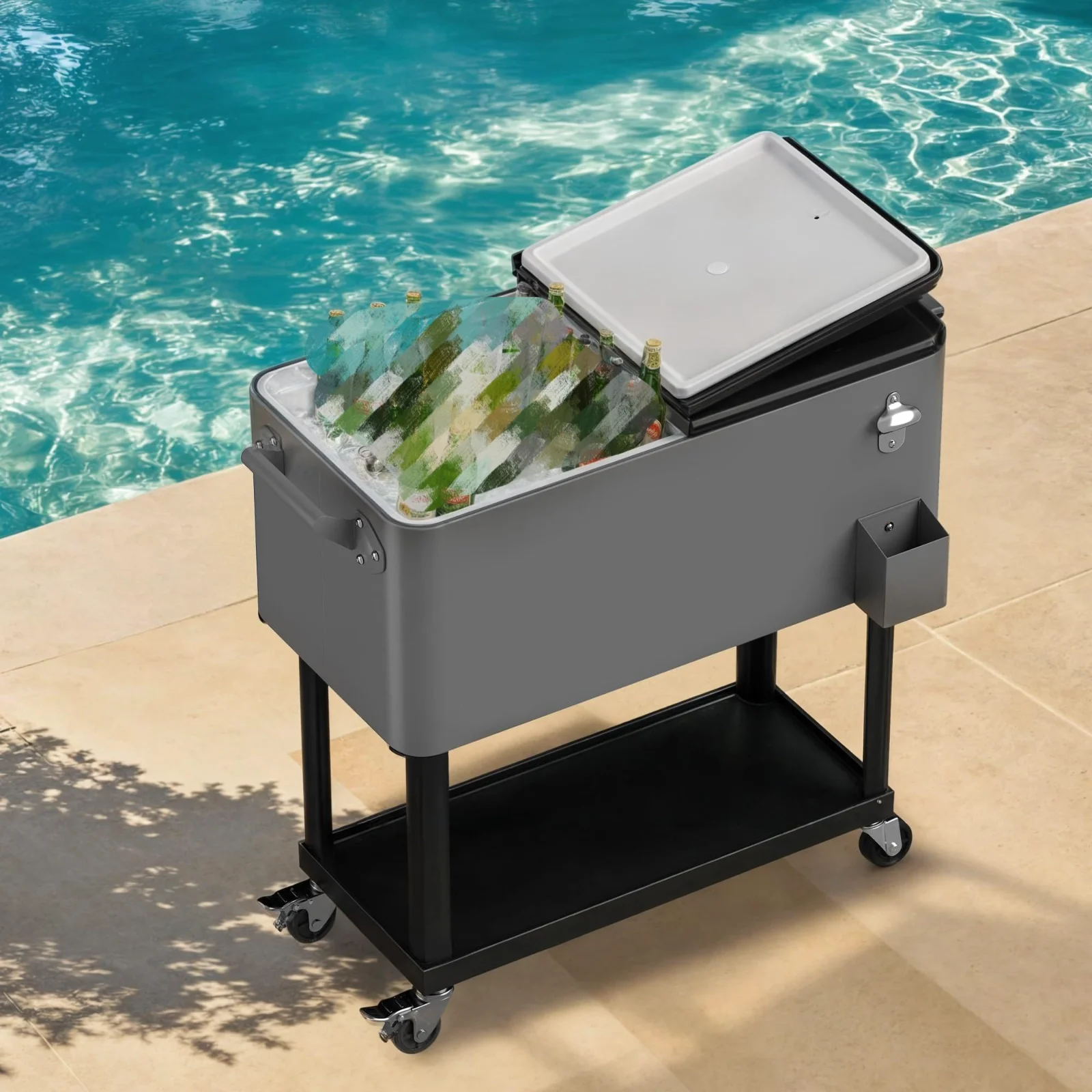
- The rules, before the gear
- What a cooler actually does
- The night before: pre-chill everything
- Packing: two coolers, layered like sediment
- Ice math, in pounds and honesty
- The failures the field reports keep reporting
- Beyond the cookout
- Running the table
- After the party: the unglamorous half
- The kit, assembled
Every cookout runs on an invisible supply line. The visible one is obvious: the grill, the table, the stack of plates. The invisible one is cold, and it is the one that decides whether Sunday evening ends with leftovers packed for Monday or with a cooler of warm water and a quiet question about the potato salad. Cold at an outdoor table is not an amenity. It is the preservation system for everything perishable on the menu, and it has rules, published by the public bodies whose job this is, that are short enough to actually follow.
Here is the whole system: what the federal food-safety guidance actually says, how a cooler physically works, how to pack one so it performs like its label, how to run the serving table, and how the rolling cooler carts we build fit into each step. It is written from the same bench as the rest of this site, and every safety figure in it is linked at the end with the date we read the source.
The rules, before the gear
Two public documents govern the outdoor table, and they are refreshingly blunt. The FDA's guidance on eating outdoors says cold food rides at 40 degrees Fahrenheit or below, in a cooler with ice or frozen gel packs, and recommends packing beverages in one cooler and perishable food in another, so the drink traffic does not warm the food. It also covers the quiet killers: raw meat wrapped securely and kept below ready-to-eat food, produce rinsed before it ever enters the cooler, and platters never reused between raw and cooked without a hot soapy wash.
The USDA's danger-zone page supplies the number that explains all of the above. Between 40 and 140 degrees, bacteria double in as little as twenty minutes, and perishable food must never sit out of refrigeration for more than two hours. In hot weather above 90 degrees, the kind of afternoon cookouts are made of, that window shrinks to one hour. Those are the fence posts. Everything else here is just engineering inside those fence posts.
The cooler is not keeping food cold for the afternoon. It is keeping food out of a temperature range where biology moves faster than the party does.
What a cooler actually does
A cooler does not make cold. It slows heat. Every degree the box holds is a negotiation between the insulation in its walls, the mass of ice inside, and the habits of the people around it. That framing sorts the market instantly. Thin-walled boxes are short-negotiation tools, fine for a two-hour errand. Thick-walled chests hold the line for days because their walls argue harder and their lids seal instead of resting. Our own lane is the third kind: the rolling cooler cart, an insulated chest raised to serving height on casters, built to be the drink station a party actually uses.
Wheels change the logistics more than people expect. A loaded chest at real capacity weighs what a checked suitcase dreams of, and the difference between a cooler that gets parked in the right place, shaded, near the table, lid downhill for the drain, and a cooler that gets abandoned at the first flat spot is usually the wheels. Casters and a handle are not luxury. They are the reason the cold ends up where the people are, and the reason our carts stand at hip height instead of shin height: a drink station nobody bends for is a drink station that stays stocked.
Three figures on any cooler card deserve a read. Quarts describe volume, and the honest conversion is that a third of the space belongs to ice, so a 60-quart chest carries roughly 40 quarts of food and drink. Ice retention days describe a closed, shaded, pre-chilled box in test conditions, so treat the number as a ceiling, not a promise. And seat-rated lids matter at a cookout for the least dignified reason: someone will sit on the cooler, every time, and the lid should be part of the plan rather than a casualty of it.
“This will make our bbq’s easier for the older folk so they don’t have to bend down to get a drink.” A five-star field report on the 80-quart rolling cart, word for word.
The night before: pre-chill everything
The single highest-leverage move in the whole cold chain happens twelve hours early. A cooler that spent the week in a hot garage enters Saturday as a warm object that will spend its first hours of ice melting into cooling the box itself. Bring the chest indoors the night before, or sacrifice a bag of cheap ice to pre-chill it, drained before packing. Meanwhile, everything that can enter the cooler already cold, should: drinks refrigerated overnight, meat and salads chilled hard, and anything freezable, water bottles, juice pouches, even the burger patties for the second batch, frozen outright. Frozen drinks are ice that becomes beverage, and the FDA guidance names frozen drinks as a legitimate cold source, and they are the only ice that nobody complains about running out of.
Block ice and frozen gel packs outlast cubes by hours because melt is a function of surface area. The working pattern: blocks or packs on the bottom, cubes filling voids, because air is the enemy inside the box just as it is inside a shed wall. A full cooler holds temperature dramatically longer than a half-empty one, and if the menu does not fill the chest, more ice does.
Packing: two coolers, layered like sediment
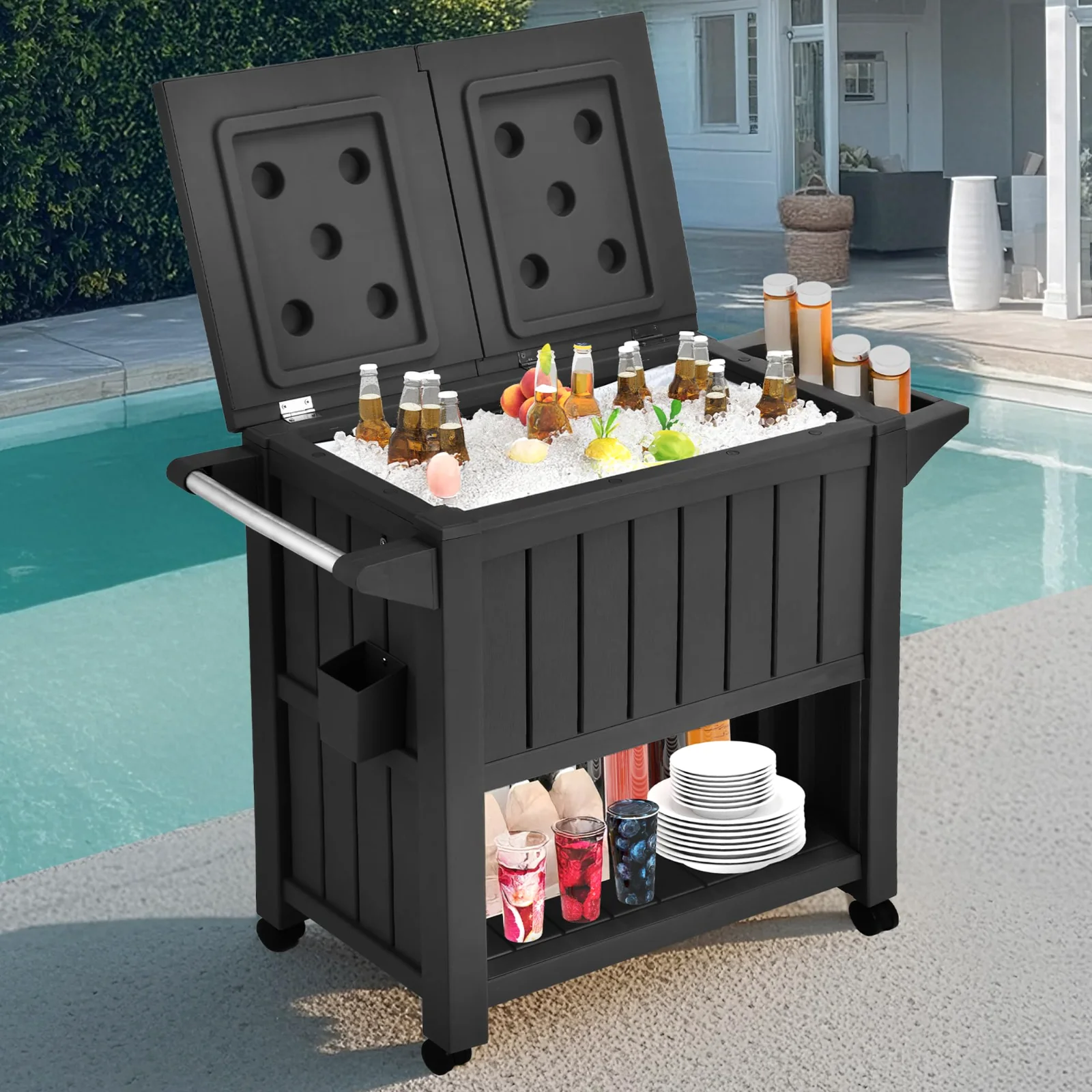
The two-cooler rule from the FDA guidance is the single most effective habit at any gathering, and it costs nothing but a second box. The drinks cooler is public infrastructure: opened forty times an afternoon, restocked from a bag of cubes, allowed to run lukewarm at the bottom of the ice by dusk without consequence. The food cooler is a vault: opened perhaps five times, parked in the shade, and holding the meat, the dairy and the salads at the 40-degree line the whole afternoon. Our rolling carts are purpose-built for the first job: an 80-quart drink station at serving height, with a shelf below for the backup bottles, exactly the public infrastructure the rule describes. The vault can then be any well-insulated chest in the shade, opened rarely. At bigger events, the ratio grows toward one drink station per cluster of guests, while the vault stays singular and serious.
Inside the vault, pack by the order of the afternoon and the rules of gravity. Raw meat goes in first, deepest and coldest, sealed in leakproof containers or double bags, so nothing it releases can travel upward onto food that will be eaten as-is. That separation is straight from the guidance and it is non-negotiable. The second-batch food, the things needed after hour two, goes low. The first-batch food sits on top, so the lid opens for seconds, not for spelunking. Condiments and produce ride highest. A cheap wire rack or a plastic bin turns the top layer into a shelf and is the best dollar-level upgrade a chest can get.
| Event | Cold plan that holds |
|---|---|
| Two-hour picnic | One chest, gel packs, everything pre-chilled |
| Afternoon cookout | Food vault plus a drinks box, block ice under cubes |
| Game day parking lot | Drinks cart by the tailgate, food vault in the shade, ice runs feed the cart |
| Camp weekend | One serious chest packed full, blocks only, opened by plan |
| Big party | One serious vault, several cheap drink stations, ice runs feed the drinks only |
Ice math, in pounds and honesty
Nobody measures ice, and everybody runs out of it, and the two facts are related. The working arithmetic is simpler than it looks. Ice performs by weight, not by bag count, and the baseline for a chest doing vault duty in summer is roughly a pound of ice for every quart of cooler you intend to keep cold, adjusted up for heat and down for pre-chilled contents. A 60-quart vault on a 90-degree afternoon wants forty to fifty pounds distributed as blocks below and cubes between. A drinks box lives happily on cubes alone because its standards are lower and its turnover higher.
The ratio that matters even more is ice to air. An honest packing session ends with the chest full, food, drink and ice together, with cubes rattled down into every void. If the menu is small, the ice share grows to fill, because a vault packed two-thirds empty spends its cold heating its own airspace every time the lid swings. This is also the quiet argument for owning one chest a size class down from your maximum event instead of one giant chest for everything: the right-sized full cooler beats the oversized empty one all summer.
Plan the resupply honestly too. On long events, ice runs happen. Route them to the drink stations only. The vault gets its ice budget at packing time and then gets left alone, because a chest that is opened to receive new ice loses more than the ice brings. If the event is long enough that the vault itself needs recharging, that is what the second set of frozen gel packs in the site freezer, swapped once at half-time, is for.
The failures the field reports keep reporting
Reading reviews across the category, ours included, the same five cookout failures repeat, and none of them is the cooler's fault. The warm start: a chest packed straight from a hot garage, spending its first thirty pounds of ice cooling plastic. The single-box party: one cooler doing vault and bar at once, opened by every thirsty guest, warm by the third hour. The sunny parking spot: a chest parked on hot pavement in full sun because that was where it rolled to a stop, paying radiant tax all afternoon. The drowned sandwich layer: food packed in leaking bags riding in meltwater because the drain stayed shut and the layers ignored gravity. And the sealed damp chest: the post-party lid clicked shut on a wet interior, opening two weeks later as a biology exhibit.
Every one of those has already been solved a section ago, which is the encouraging part. The cold chain is not a talent. It is a checklist, and the equipment meets it more than halfway. Thick walls buy forgiveness for the lid habit, wheels buy the shaded parking spot, the drain buys dry layers, and the pre-chill is free to anyone who reads this the night before instead of the morning of.
Beyond the cookout
A serious chest earns its garage space in the off-season too. It is the grocery run's insurance on hot days, the fishing trip's fish box, the camp kitchen's refrigerator, and the road trip's answer to gas-station lunch. The same rules travel with it unchanged: cold source below, perishables sealed, the 40-degree line respected, the two-hour clock running whenever something perishable leaves the cold. A chest that hunts or fishes gets the same soap-and-dry treatment afterward as the party vault, with more conviction.
One boundary is worth stating because the field reports occasionally test it: a cooler is short-term cold storage, not refrigeration. It holds a safe temperature for a span measured in hours and, packed expertly, a weekend. It does not certify anything beyond what its thermometer can prove. For long outages and emergencies, the public agencies publish their own dedicated guidance, and a household that owns a good chest should still read it rather than improvise from a cookout guide. Our lane here is the equipment and the afternoon, and the sources below are the authorities on everything past it.
“Easy assembly. Holds ice cold for three days, even in the sun.” A five-star field report on the 80-quart cart, word for word.
Running the table
Serving is where good packing goes to die, so the table needs its own rules, and they are the same three the agencies publish. Small platters, refilled often, beat large platters standing in the sun. The portion on the table is the portion inside the two-hour clock, and above 90 degrees, the one-hour clock. Cold dishes sit in trays of ice if they are staying out, and the serving spoon stays with its dish. Hot food off the grill holds above 140 on the grill's warm side, which the shade guide's grill-placement note makes easier by putting the cook's station where the fire can breathe.
The clock is the discipline that survives contact with a party least, so borrow a trick from catering: when the platter goes out, set a phone timer. When it rings, what is on the table gets eaten, iced or binned, and the vault opens for the next round. It feels ruthless the first time and normal by the second cookout, and it is the entire difference between leftovers and regrets. When in doubt afterward, the rule the agencies repeat is four words long and cheaper than any night that ignores it: when in doubt, out.
Placement, one more time, because it is free performance: the chest lives in the shade. Under the gazebo, under the canopy, under the table if nothing else offers, per the shade guide, because a cooler in the sun is fighting radiant load on top of air temperature, and the ice pays for it hour by hour.
After the party: the unglamorous half
The cold chain runs in reverse at dusk. Leftovers that lived by the rules go back below 40 promptly, in shallow containers so they chill through, and anything that overstayed its clock does not get a sentimental exception. The chest drains where the water does good instead of harm, which is what a real drain plug is for, and then it is cleaned like the food equipment it is: warm soapy water, a rinse, and a genuinely complete dry with the lid propped open, because a cooler sealed damp brews the smell that reviews describe with such feeling. Baking soda paste handles stains, sun handles odors, and gaskets get a wipe and a look.
Storage is the storage guide's department, but the short version fits here: the rolling cart winters clean, dry, lid cracked open, somewhere out of the sun. A deck box or a shed shelf suits it perfectly, and the backyard storage plan has the gallons math for the rest of the cookout kit, the folding chairs and the canopy bag included. Everything on the DWVO lot is built to spend its off-season in something else we build, which is not an accident.
The kit, assembled
Strip all of it to a checklist and the cold chain costs one evening of preparation and no willpower at all. The night before: chest indoors, drinks and meat chilled hard, blocks in the freezer, bottles frozen. The morning: vault packed by layers, raw meat sealed and lowest, drinks box loaded separately, both parked in shade at the site. The afternoon: vault opened by plan, platters small, the timer running, refills from below. The evening: leftovers down fast, the clock respected, the chest drained, washed and dried open.
The rolling carts we build for the drink-station role are on the front page with their quarts in plain type, every figure from our last update, and the two public documents everything above leans on are linked below with the dates we read them. Read them once. They are short, they agree with each other, and they are the reason the last burger of the evening is as safe as the first.
